The biggest IPO ever might have just put the space industry in the spotlight for investors. Are we already part of this sector making an impact, or is it time to explore how innovators from this city could contribute to the emerging space economy?
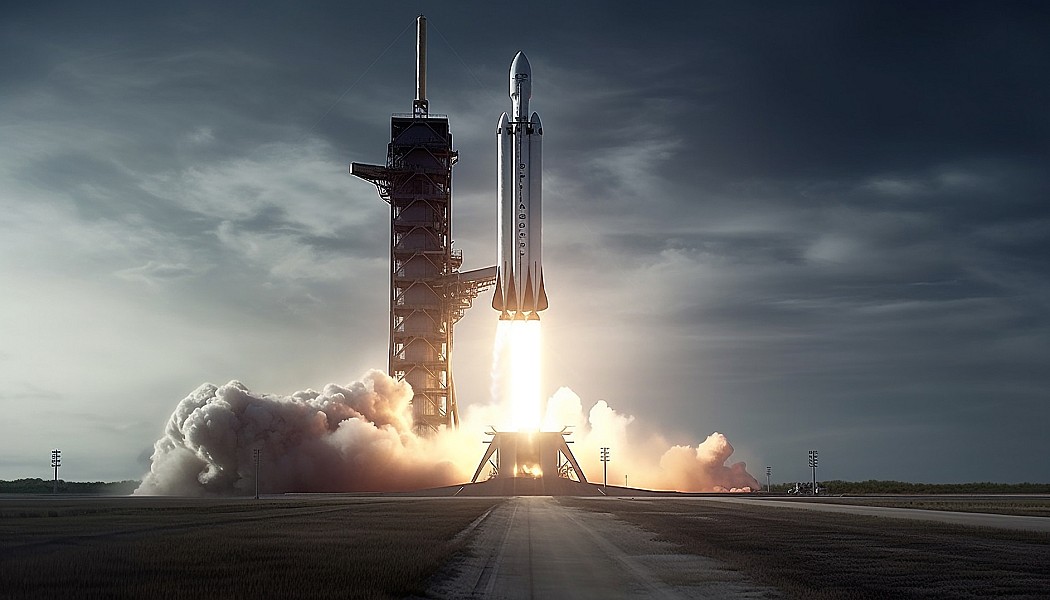
On Friday, June 12, 2026, SpaceX listed on the Nasdaq under the ticker SPCX. The stock was priced at $135 per share, opened at $150, and closed its first day at $160.95, up 19.2%. The IPO raised $75 billion, the largest in history. (Sources: NBC News | Yahoo Finance)
SpaceX's listing was a historic event that drew widespread attention, especially in the capital markets. The event has signalled to moonshot investors that the future is near and that the market is ready to recognize the intrinsic value of assets in the space industry. With space exploration and artificial intelligence as hot topics in capital markets, is this the time for a city like Edmonton to promote and showcase itself as an engineering city with serious AI talent, critical mineral reserves, and a moonshot mindset?
The Direct Connections
While Edmonton has fewer direct space industry players compared to Toronto or Montreal, the existing ones are significant, with two particularly notable figures:
1. Wyvern
Wyvern, based in Edmonton, was founded in 2018 by four University of Alberta graduates. It runs the world's first commercial hyperspectral satellite constellation, offering Earth observation imagery for defence, agriculture, mining, and forestry sectors. The company has secured around $27.4 million in total funding and is an early investor in Y Combinator (W22 batch). (Sources: PitchBook | Y Combinator | Wyvern Space)
Wyvern's link to SpaceX is straightforward, with several Dragonette satellites already launched on Falcon 9 rockets during Transporter rideshare missions (Transporter 7, 8, 9, 13, and 15). In February 2026, Wyvern secured a strategic investment from NordSpace Ventures as part of a Canadian sovereign space ecosystem initiative.
2. AlbertaSat
The University of Alberta hosts AlbertaSat, a student and faculty team responsible for designing, constructing, testing, and managing satellites. They created Ex-Alta 1, Alberta's first satellite, launched from the International Space Station in 2017. Ex-Alta 2 was launched on SpaceX CRS-27 in March 2023. Currently, they are working on Ex-Alta 3, which is expected to launch in 2026. (Source: CBC News) This means Edmonton has two verified, active satellite programs with flight experience on SpaceX rockets. While few in number, they are significant as a strong foundation.
The Indirect Connections
The more compelling story lies in Edmonton's neighbouring strengths. The space economy isn't solely about rockets; it also relies on AI, critical minerals, advanced materials, and engineering talent capable of working in extreme environments. Edmonton possesses significant capabilities in all four fields.
AI and machine intelligence:
The University of Alberta ranks first in Canada and 53rd globally for artificial intelligence according to the U.S. News 2025-2026 Best Global Universities Rankings. The Alberta Machine Intelligence Institute (Amii), based in Edmonton, is one of three federally funded AI research centres included in the Pan-Canadian AI Strategy. (Source: Amii & U of A leadership) This research strength is already extending into the aerospace industry. In July 2025, Amii was part of a $13.9 million AI initiative in aerospace focused on predictive maintenance with reinforcement learning, supported by $3 million from Scale AI. (Source: Amii AI-Aerospace Project)This is significant for the space economy because SpaceX now considers AI central to its future strategy. After merging with xAI in February 2026, SpaceX has mentioned AI data centres in space in its plans and communications. (Source: TechCrunch) The emerging space economy will require extensive AI infrastructure, both on the ground and eventually in orbit, and Edmonton’s research capacity positions it well to contribute.
Critical Minerals:
This is where Alberta's strategic importance really becomes evident. According to the Alberta Geological Survey, the province holds about 82.5 million tonnes of lithium carbonate equivalent, making it potentially one of the world's largest lithium reserves. This resource is valued at roughly $1 trillion. (Sources: BNN Bloomberg | Daily Commercial News) Alberta also has 15 critical minerals listed on Canada's official list, including the top six: lithium, graphite, nickel, cobalt, copper, and rare earth elements. The University of Alberta is establishing itself as a global center for critical minerals expertise, spanning the entire value chain from exploration to recycling, and is playing a significant role in the Western Canadian Critical Minerals Strategy, signed in 2026. (Source: U of A Folio) The space industry relies heavily on these materials. Satellite manufacturing, propulsion, batteries, and electronics all depend on critical minerals that Alberta possesses in abundance. Companies like E3 Lithium are already working to commercialize lithium extraction from oil and gas brine, with production expected to start between 2028 and 2029.
Engineering and extreme-environment expertise:
Edmonton's role in the space industry isn't about providing fuel, since major chemical companies supply rocket-grade fuels globally, making Edmonton's contribution more about engineering expertise than commodity production. With fifty years of oil sands engineering experience, Edmonton has developed a highly skilled workforce experienced in operating in extreme environments, handling complex materials, managing safety-critical systems, and industrial chemistry at large scales. These skills are directly applicable to space hardware development. For instance, Edmonton-based Zero Point Cryogenics, which makes dilution refrigerators for quantum computing, demonstrates the city's ability to adapt its industrial culture to frontier technologies. The talent exists; the key is whether the city will organize itself to leverage it.
The Opportunity, and What it Would Take
Over the past five years, Edmonton's tech sector has raised more than $2.7 billion in venture capital, including $170 million across 95 deals in 2024 alone. (Source: Startup Genome) The necessary infrastructure is already in place, with organizations such as Edmonton Unlimited, Startup TNT, Amii, Alberta Innovates, and over 20 other ecosystem groups. Local universities produce graduates with strong technical backgrounds, and the minerals are underground.
However, what’s missing is a coordinated effort to develop our presence in the moonshot innovation space. Edmonton has an innovative mindset, but it has yet to organize itself around sectors like Montreal’s aerospace or Toronto’s AI commercialization. The recent SpaceX IPO signals that capital markets are increasingly willing to place trillion-dollar valuations on deep-tech and space-related companies.
Companies that position themselves credibly within the next 12 to 24 months may be well positioned to attract attention and funding. Edmonton has the essential inputs: advanced AI research, critical mineral reserves, a strong engineering culture, existing space companies, and a robust ecosystem. What’s needed now is intentional action from founders focused on deep-tech and space-related challenges rather than defaulting to SaaS, investors supporting hardware innovations, and universities and accelerators highlighting space and frontier-tech opportunities alongside their current programs. The opportunity is available; whether Edmonton seizes it or lets it pass remains to be seen.
Edmonton Got Next.